Why It’s Needed (Context)
Imagine an airport where every passenger receives the same security screening.
A tourist flying domestically gets treated exactly like a diplomat carrying sensitive government documents.
Sounds inefficient.
Now imagine a library where every book is locked inside a vault.
Or a company where every file is encrypted, monitored, and restricted as if it contained merger plans.
Security doesn’t fail because organizations lack controls.
Security fails because organizations don’t know which controls belong where.
This is why Information and Asset Classification sits at the heart of CISSP Domain 2: Asset Security.
Classification determines:
- Who can access data
- How data is stored
- How data is transmitted
- Whether encryption is required
- How long data is retained
- How it is destroyed
Every downstream control depends on the classification decision.
If classification is wrong, every security control built on top of it is wrong.
The CISSP exam is not testing whether you can memorize labels.
It is testing whether you understand:
- Who owns classification decisions
- How classification is determined
- How classification drives security controls
- Why accountability belongs to the business, not IT
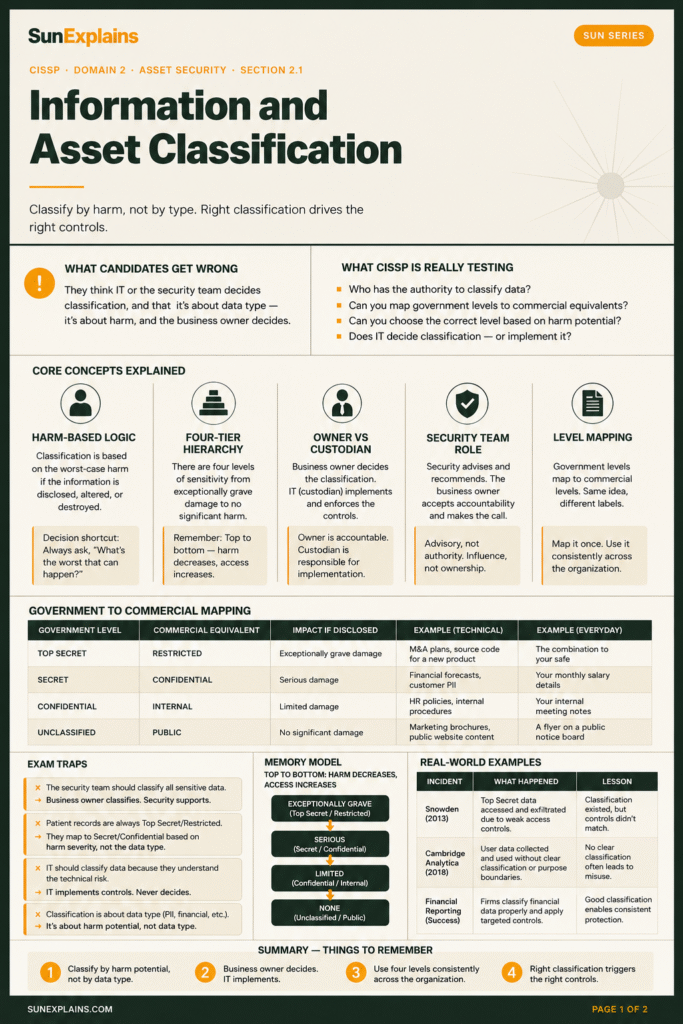
Core Concepts Explained Simply
Concept 1: Information Classification
Technical Definition
Information classification is the process of assigning a sensitivity level to information based on the potential damage that could occur if the information is disclosed, altered, or destroyed.
Everyday Example
Think about keys in your home.
- Front door key = highly sensitive
- Mailbox key = moderately sensitive
- Spare garden shed key = low sensitivity
You protect each key differently because losing them causes different levels of harm.
Technical Example
An organization classifies:
- Acquisition plans as Restricted
- Employee salaries as Confidential
- Internal procedures as Internal
- Marketing brochures as Public
Each classification receives different security controls.
Concept 2: Harm-Based Classification
Technical Definition
Classification is determined by the severity of harm that would result if information were compromised.
Everyday Example
A family photo and a bank account password are both digital files.
The file type is the same.
The impact of exposure is completely different.
The password deserves stronger protection because the harm is greater.
Technical Example
Patient medical records may be classified differently across organizations.
Why?
Not because they are healthcare data.
Because organizations assess different business impacts if those records are exposed.
Classification follows harm, not data type.
Concept 3: Data Owner
Technical Definition
The data owner is the individual with accountability and authority to determine classification and protection requirements.
Everyday Example
If you own a house, you decide:
- Who gets a key
- Which rooms are restricted
- What security system is installed
You may hire contractors to implement security.
You still make the decisions.
Technical Example
The Chief Financial Officer (CFO) owns:
- Financial forecasts
- Budget reports
- Revenue projections
The CFO decides the classification.
Not the IT department.
Not the security team.
Concept 4: Data Custodian
Technical Definition
A data custodian implements and maintains security controls based on the owner’s requirements.
Everyday Example
A security company installs your alarm system.
They implement protection.
They do not decide who owns the house.
Technical Example
IT administrators:
- Configure permissions
- Apply encryption
- Perform backups
- Manage storage systems
They enforce the owner’s decisions.
They do not determine classification.
The Four-Tier Classification Hierarchy
Government Classification Model
| Level | Impact if Disclosed |
|---|---|
| Top Secret | Exceptionally grave damage |
| Secret | Serious damage |
| Confidential | Limited damage |
| Unclassified | No meaningful damage |
Commercial Classification Model
| Level | Impact if Disclosed |
|---|---|
| Restricted | Exceptionally grave damage |
| Confidential | Serious damage |
| Internal | Limited damage |
| Public | No meaningful damage |
Simple Memory Mapping
| Government | Commercial |
|---|---|
| Top Secret | Restricted |
| Secret | Confidential |
| Confidential | Internal |
| Unclassified | Public |
Memory Compression Model
Exceptionally Grave Damage
        ↓
Top Secret / Restricted

Serious Damage
        ↓
Secret / Confidential

Limited Damage
        ↓
Confidential / Internal

No Damage
        ↓
Unclassified / Public
Remember:
Classification follows damage potential.
Not file type.
Not industry.
Not compliance requirements.
Decision Logic CISSP Wants You to Use
Whenever you see a classification question:
Step 1
Ask:
What is the worst-case business impact if this information is disclosed?
Step 2
Determine the classification level based on harm.
Step 3
Identify the owner.
Step 4
Allow IT and security teams to implement controls.
CISSP Exam Shortcut
What is the data?

Wrong Question.

What harm occurs if disclosed?

Correct Question.
Real-World Case Study
Failure Case: Snowden (2013)
Situation
Contractor Edward Snowden accessed highly classified intelligence information within the U.S. government.
Many of the documents carried appropriate classifications.
The problem was not classification.
Impact
Massive disclosure of intelligence programs.
Global diplomatic consequences.
Loss of trust.
Operational disruption.
Lesson
Classification alone provides no protection.
Controls must align with classification.
The chain should be:
Classification
      ↓
Access Control
      ↓
Monitoring
      ↓
Least Privilege
      ↓
Protection
Classification existed.
Least-privilege enforcement failed.
Failure Case: Cambridge Analytica
Situation
Large quantities of social media data were collected and used beyond expected purposes.
Impact
Privacy concerns.
Regulatory scrutiny.
Reputational damage.
Consumer trust erosion.
Lesson
Data may technically be collected correctly but still lack appropriate governance boundaries.
Classification must include:
- Purpose definition
- Usage restrictions
- Ownership accountability
Without governance, classification becomes a label instead of a control.
Success Case: Financial Services Data Governance
Many mature financial institutions assign ownership to:
- CFO for financial data
- Chief Risk Officer for risk data
- HR Director for employee records
- Marketing leadership for customer analytics
This creates clear accountability.
When new controls are needed:
- Owner decides
- Security advises
- IT implements
The result is stronger governance and fewer classification disputes.
Action Framework
Prevent
Establish Ownership
Assign a business owner for every critical information asset.
Examples:
- CFO → Financial Data
- CMO → Customer Data
- HR Director → Employee Data
Define Classification Criteria
Document:
- Restricted
- Confidential
- Internal
- Public
Use business impact definitions.
Train Employees
Ensure everyone understands:
- Classification labels
- Handling requirements
- Escalation procedures
Detect
Review Access Rights
Verify permissions align with classification levels.
Audit Data Repositories
Identify:
- Unclassified sensitive data
- Overexposed information
- Ownership gaps
Monitor Data Movement
Track:
- Downloads
- Sharing
- Transfers
- External exposure
Respond
Reclassify When Necessary
Business conditions change.
Classification may need adjustment.
Investigate Violations
Determine:
- Root cause
- Ownership gaps
- Process failures
Update Controls
Adjust:
- Encryption
- Access restrictions
- Monitoring
- Retention requirements
Common CISSP Confusions
Confusion #1
IT owns the data because IT manages the servers.
Reality:
Ownership is accountability.
Management is administration.
Ownership belongs to the business.
Confusion #2
PII is automatically Restricted.
Reality:
Classification depends on impact.
Not category.
Not regulation.
Not file type.
Confusion #3
Security determines classifications.
Reality:
Security advises.
Business decides.
IT implements.
Confusion #4
More sensitive always means more secure.
Reality:
Overclassification creates operational friction and increases cost.
Protection should match risk.
Exam Traps CISSP Loves
Trap 1
“The security team should classify all sensitive information.”
Correct Answer:
The business owner classifies information.
Security supports the process.
Trap 2
“IT should classify data because they understand the technical risk.”
Correct Answer:
Technical expertise does not create ownership.
The business owner decides.
IT implements.
Trap 3
“Patient records are always Top Secret.”
Correct Answer:
Classification depends on damage severity.
Healthcare records often align with Confidential or Restricted depending on business impact.
Trap 4
“The system administrator owns the database.”
Correct Answer:
Administrators manage systems.
Business leaders own data.
Key Differences to Keep in Mind
| Concept | Difference | Example |
|---|---|---|
| Owner vs Custodian | Owner decides, custodian implements | CFO classifies, IT enforces |
| Classification vs Labeling | Classification is decision, labeling is marking | Data may be classified before labels are applied |
| Data Type vs Harm Potential | Harm drives classification | Customer email list and marketing brochure are both files but have different impacts |
| Security vs Ownership | Security advises, owner decides | Security recommends controls; business approves |
| Access vs Accountability | Access does not equal ownership | DBA may access data but does not own it |
Summary Table
| Concept | Definition | Everyday Example | Technical Example |
|---|---|---|---|
| Classification | Assign sensitivity based on impact | Protecting house keys differently | Assigning Restricted, Confidential, Internal, Public |
| Harm-Based Logic | Impact determines classification | Password vs family photo | Financial forecasts vs public brochure |
| Data Owner | Accountable decision-maker | Homeowner deciding security | CFO classifying financial data |
| Data Custodian | Implements controls | Alarm installer | IT administrator configuring permissions |
| Restricted / Top Secret | Exceptionally grave damage | Master vault key | Strategic merger documents |
| Confidential / Secret | Serious damage | House key | Customer financial records |
| Internal / Confidential | Limited damage | Shed key | Internal procedures |
| Public / Unclassified | No meaningful damage | Public park map | Marketing website content |
ASCII Visualization
Business Owner
       │
       ▼
Determine Harm
       │
       ▼
Assign Classification
       │
       ▼
Security Advises
       │
       ▼
IT/Custodian Implements
       │
       ▼
Controls Applied

Encryption
Access Control
Monitoring
Retention
Destruction
🌞 The Last Sun Rays…
Remember the three questions CISSP keeps asking:
Who decides classification?
The business owner.
How is classification determined?
By the potential harm caused if the information is disclosed.
Who implements protection?
The custodian, typically IT.
The biggest misconception in security governance is believing that the team closest to the technology should own the data.
CISSP teaches the opposite.
The people closest to the business impact own the data.
The people closest to the technology implement the controls.
That’s why your CFO owns financial data.
Your CMO owns customer data.
Your HR Director owns employee records.
And if your IT team is deciding what counts as sensitive, your governance model is already broken before a single security control is deployed.
Owner decides. Custodian implements. Always.
Reflective Question
If you walked into your organization tomorrow and asked, “Who owns our most sensitive customer data?”—would everyone give the same answer?
For the full lifecycle of how data is managed and protected beyond classification, see Data Security Explained: Classification, Ownership, Retention, and Protection. The roles of data owners and custodians in managing information assets are explored in Information Ownership and Asset Management in CISSP Domain 2.3. Classification also connects directly to information handling procedures, which are covered in Information Handling Requirements: Why Data Classification Alone Is Not Enough.
For official resources, visit (ISC)² CISSP Certification.
Related reading: Explore more in-depth coverage across the CISSP Study Guide and other resources listed below.
- CISSP Study Guide — the complete roadmap for all 8 CISSP domains
- CISSP Elite Framework — exam-focused revision content
- Data Security — protecting assets once classified
- Domain 3: Security Architecture and Engineering — the architectural controls that protect classified assets

By profession, a CloudSecurity Consultant; by passion, a storyteller. Through SunExplains, I explain security in simple, relatable terms — connecting technology, trust, and everyday life.
Leave a Reply